
Why One Radius Can Change the Entire Look of a Custom Furniture Piece
When people talk about custom furniture, they usually focus on materials, finishes, colors or craftsmanship. Those are all important.
But in many luxury hospitality, retail and commercial projects, there is one detail that quietly determines whether a piece looks premium or ordinary. It is the radius. Not the marble. Not the paint. Not the stainless steel.
Just one curve.
Most designers don’t notice the radius. Most experienced manufacturers do.
Many projects start with a beautiful rendering. The shape looks soft. The reflections look elegant. Everything feels balanced.
Then production begins.
Weeks later, the finished furniture arrives. The client says, “It looks different.”Nothing is actually wrong. The dimensions are correct. The material is correct. The color is correct. Yet everyone feels something has changed.
In many cases, the difference comes from something almost invisible—the radius.
A radius is not just a corner. It controls how light moves across the object.
This is something many people underestimate. Our eyes don’t actually judge furniture by dimensions first. We judge it by light. Light reveals volume. Light reveals curves. Light creates shadows. When a radius changes even slightly, the highlight moves. The reflection changes. The shadow becomes harder or softer. Suddenly the same object gives a completely different visual emotion. That is why luxury furniture always feels calm and expensive. Not because it uses expensive materials. Because every transition is controlled.
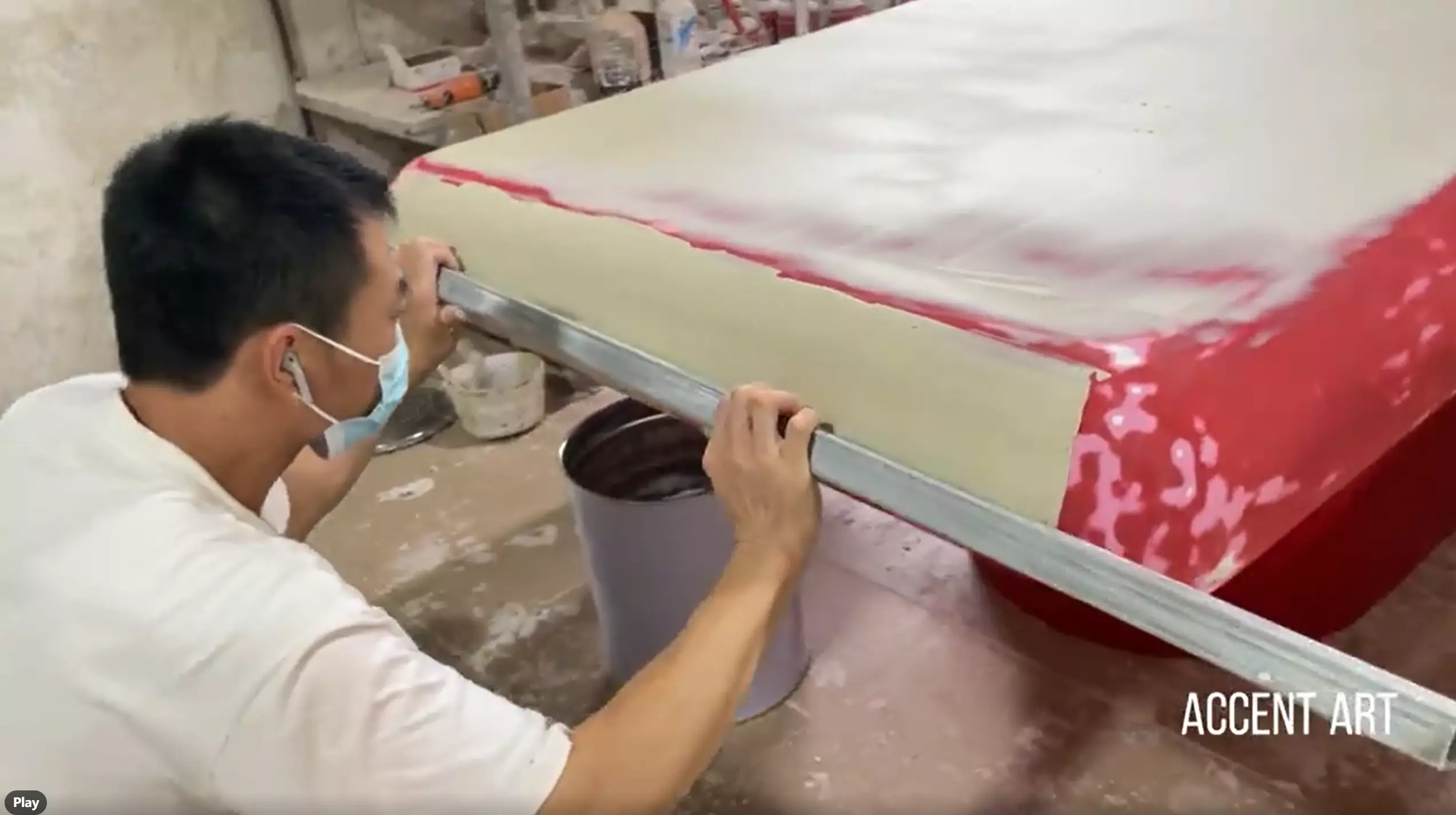
As shown in the video attached to this article, this heavy, design-oriented large dining table was created by an American designer for a client’s mansion. The designer requires the desktop to be flat. After passing through the lighting inspection and several coating processes, we noticed minor irregularities. In the video, our experienced technician carefully addresses the chamfering and surface flatness repeatedly.
Why doesn’t the CAD file solve this?
This surprises many project managers. A CAD drawing tells us dimensions. It rarely tells us visual feeling. For example, the drawing may simply specify: R20. But should that R20 continue consistently through the entire transition? Should it gradually increase? Should it flatten before reaching the edge? Should different materials share exactly the same radius? These questions are rarely answered in construction drawings. Yet they determine the final appearance. That is why engineering development is so important before manufacturing begins.
This entirely depends on the manufacturer’s experience, strong sense of responsibility, and high aesthetic standards.
Different materials require different radius strategies.
This is another mistake we often see. Designers naturally think about form.Manufacturers must think about material behavior.
For example:
- An FRP sculpture allows continuous flowing curves.
- Solid wood requires structural stability.
- Engineered stone has minimum machining limitations.
- Mirror stainless steel magnifies every tiny change in curvature.
- Resin behaves differently under polishing.
- Concrete has another set of edge limitations.
If one radius is copied directly across every material, the final product may lose the original design language.Instead of making every radius identical,our job is to make every material create the same visual feeling.Those are two completely different goals.
Radius also affects manufacturing.
People usually associate radius with aesthetics.In reality, it also affects production.A tighter radius often means:
- more complicated molds
- additional sanding
- longer polishing
- more difficult painting
- higher rejection rates
- increased finishing time
Sometimes increasing a radius by only a few millimeters dramatically improves manufacturability while keeping exactly the same visual effect. That is where engineering experience creates value. Good engineering protects both appearance and production efficiency.
Luxury furniture is rarely about making things more complicated.
It is about making complexity invisible.The best custom furniture never asks people to admire the craftsmanship.People simply feel,”This looks right.”They may never notice the radius.But they notice the harmony.They notice the balance.They notice that the furniture feels intentional.That is what separates a custom project from a truly engineered custom project.
Before production, ask one extra question.
Instead of only asking,”Is the dimension correct?”
Ask,”Will this radius still create the same feeling after it is manufactured?”
That single question often determines whether the finished project matches the rendering—or merely resembles it.Because in high-end custom furniture, sculptures, reception desks, retail displays, hospitality interiors and architectural feature pieces,details don’t decorate the design.They define it.